
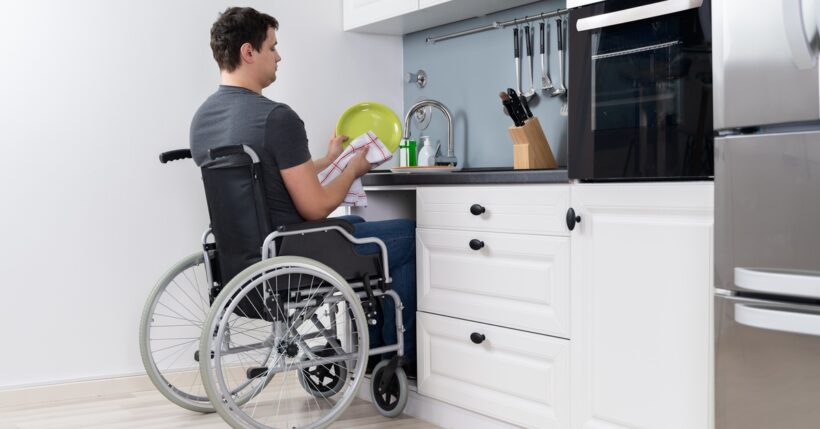
Everybody loves the kitchen, but not everyone can use it easily. For your loved ones who roll instead of walk, a standard kitchen can feel more like an obstacle course than a culinary haven. They might struggle to reach things on a counter, turn on faucets, navigate around an island, and so forth.
If you’re ready to turn that frustration into freedom, you’ve come to the right place. We’re going to break down some ways to make your kitchen accessible for wheelchair users. Let’s dive in.
Lower the Countertops
Most standard countertops sit at about 36 inches high, which is perfect for standing but a total pain when you’re seated. Dropping all (or at least a section) of the counter to about 30 inches allows your loved one to prepare, plate, and enjoy meals comfortably without straining their shoulders. Additionally, make sure there’s open space underneath that lower section so their knees have somewhere to go.
Rethink Your Sink
Is your sink a hurdle or a help? A shallow sink (about 5 to 6 inches deep) allows a wheelchair user to reach the bottom without leaning dangerously forward. Another good upgrade to make is moving the drain to the rear of the sink, as this frees up under-sink space for legs. Combine this with a single-lever faucet or a touchless model, and you’ve got a setup that is easy, efficient, safe, and modern.
Safety Tip
Don’t forget to insulate any exposed hot water pipes underneath to prevent your loved one from burning their legs when they roll up to the sink.
Adjust Appliance Placement and Design
You must make sure your kitchen’s most-used appliances are either reachable or upgrades with accessibility in mind. Consider these ideas:
- Place appliances like microwaves, ovens, and dishwashers at reachable heights.
- Install a wall oven with a side-hinge door (so wheelchair users don’t have to reach over a hot door to get a dish).
- Upgrade to a dishwasher drawer or raise the dishwasher 6 to 8 inches off the floor to limit how much bending your loved one needs to do.
In fact, these are the kind of kitchen remodeling ideas that improve function and flow for everyone, not just wheelchair users.
Install Pull-Out Shelves
Digging into the back of a deep cabinet is annoying for anyone, but it’s nearly impossible from a wheelchair. Installing pull-out shelves or lazy Susans brings the contents of the cabinet to you. Suddenly, pots, pans, spices, and Tupperware lids are easily accessible. Furthermore, opting for D-shaped handles instead of knobs makes opening those drawers a breeze for hands that might not have the strongest grip.
Widen Traffic Lanes
Standard walkways can be tight, especially if there’s a kitchen island involved. A wheelchair needs a turning radius of at least 60 inches to maneuver comfortably. Therefore, rearranging movable furniture or rethinking the layout to create wider paths is an essential part of making your kitchen accessible to wheelchair users. It prevents that awkward multi-point turn just to get to the fridge. Ultimately, giving your loved one space to move freely gives them back their independence, and that’s the best gift you can give.